Rug Patching.
For larger holes or burn damage where reweaving is not economical — a graft from an unseen part of the rug or a donor rug.
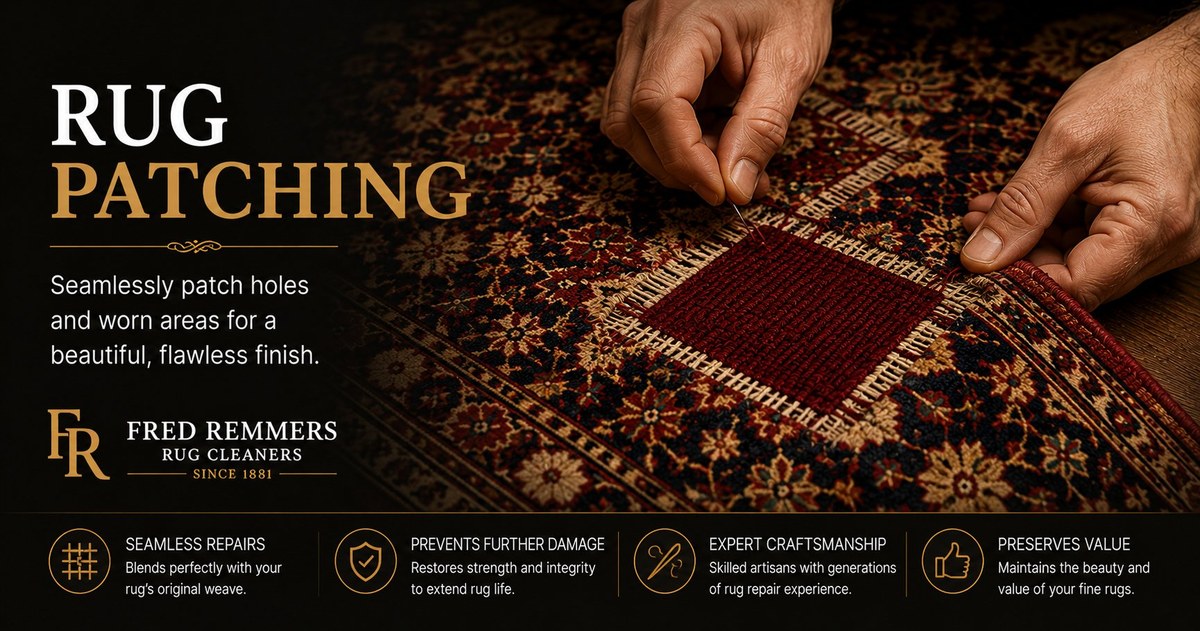
How patching works
A section is cut from a low-visibility area of the same rug (an edge that will be trimmed and serged) or from a donor rug of similar age and construction. The patch is fitted exactly to the damaged opening, secured to the foundation, and finished from the front.
When we recommend it
When the damage is too large or too geometrically simple to reweave economically. Often the right call for solid-field rugs, where the missing pattern is uniform and a clean graft is undetectable.
When we do not
Highly patterned or rare rugs deserve the time of a reweave. We choose the method that is right for the rug, not the one that is fastest. We will explain the trade-offs before you decide.
Patching vs. full reweaving.
Patching is a hole-repair technique that's faster and less expensive than full reweaving — but it's only appropriate for certain situations. The technique inserts a matched piece of rug material into a damaged area, then secures it through the foundation with hand stitching. Done well on the right rug, the repair is acceptable. Done wrong or on the wrong rug, it's immediately visible.
Patching works best on machine-made rugs, hand-tufted designer pieces, and lower-density hand-knotted rugs where exact pattern continuity isn't critical. The patch material can be sourced from a discreet area of the rug itself (the back of a corner, an unseen edge), from a similar rug, or from new matched material. The patch is shaped to fit the hole exactly, then secured with foundation stitching that's invisible from the front.
For finer hand-knotted oriental rugs — Persians, Turks, fine Caucasians, anything with appraisal value — we usually recommend reweaving over patching. The pattern continuity, knot density matching, and color integration all work better with traditional reweaving methods. Patching on a fine piece typically reduces value rather than preserving it.
Patching costs run $50–$300 per repair area for most rugs, depending on size and complexity. We always inspect the rug and recommend patching versus reweaving honestly — patching when it's the right answer, reweaving when the rug warrants it.
Repairing holes and damage.
Patching repairs a defined area of loss — a moth hole, a cigarette or ember burn, a pet-chewed corner, or a tear. The right approach depends on the rug and the damage: we either reweave a new section directly into the foundation, or graft in a carefully matched piece from a donor rug.
Either way, the foundation is repaired first so the patch is anchored, then the surface is blended into the surrounding pattern and sheared level. On a hand-knotted rug the goal is a repair that holds structurally and disappears visually; on a more utilitarian rug, a sound, tidy patch is often the practical choice.
- Moth holes, burns, tears, and pet damage
- Rewoven insert or matched donor patch, chosen to fit the rug
- Foundation anchored before the surface is rebuilt
- Pattern and pile blended into the surrounding field
Common questions about patching.
Should I patch or reweave?
Will the patch be visible?
Can you match the pattern around the hole?
Part of our rug repair service. Related: Rug Repair, Rug Reweaving, and Overcasting & Stitching.
Available across five metros.
Free pick-up and delivery in every city we serve. Tap a city for local details and your nearest phone number.