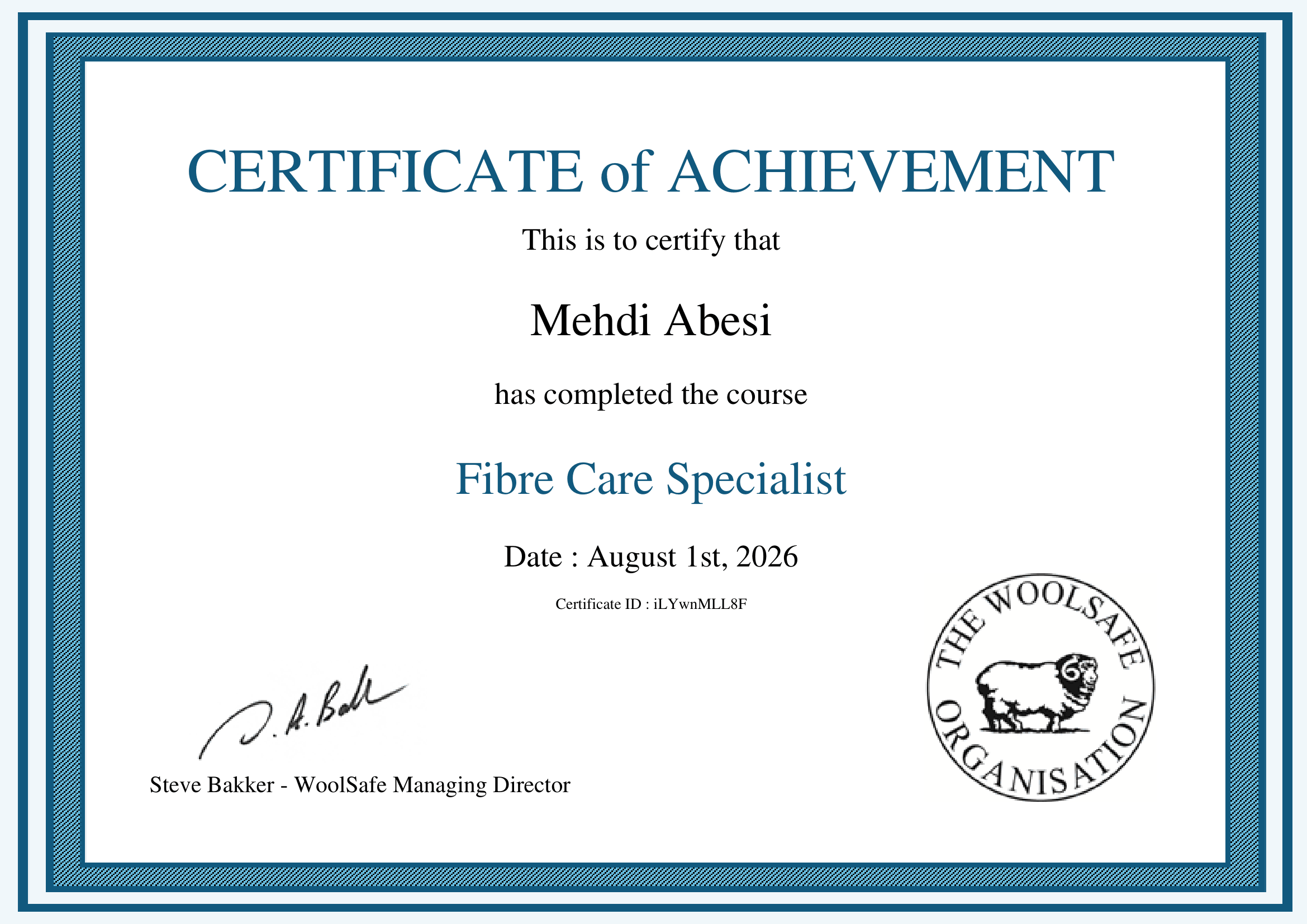
Mehdi Abesi is a WoolSafe Fibre Care Specialist
On August 1, 2026, Mehdi Abesi completed The WoolSafe Organisation’s Fibre Care Specialist course — formal, examined training in fibre identification and the safe cleaning of wool and other natural fibres. Here is what that actually means for the rug on your floor.
The short version: Mehdi Abesi has completed The WoolSafe Organisation’s Fibre Care Specialist course, an examined qualification in fibre identification and safe cleaning chemistry for wool and other natural fibres. WoolSafe has run the training since 1999 and sets a written exam with an 80% minimum pass mark. Mehdi scored 98%. In practical terms: the person assessing your rug has been formally tested on the judgment calls that most often ruin rugs.
Key takeaways
- Mehdi Abesi completed the WoolSafe Fibre Care Specialist course on August 1, 2026.
- The qualification is examined, not merely attended — WoolSafe requires a written exam at 80% minimum. Mehdi scored 98%.
- The training centres on fibre identification and safe cleaning chemistry — the two things that decide whether a wash helps or harms.
- To be precise: this is an individual qualification, which is a different thing from company-level WoolSafe Approved Service Provider status.
What the qualification actually is
The WoolSafe Organisation is an independent certification body founded in 1991, devoted to best practice in the care of wool and other natural fibres. It tests and certifies cleaning products, maintains directories of approved specialists, and runs training through the WoolSafe Academy. Its Fibre Care Specialist course has been running since 1999.
The part worth knowing, because it is what separates this from a great many credentials in the cleaning trade: it is examined. The course concludes in a written exam, and WoolSafe sets a minimum pass mark of 80 percent. Mehdi scored 98 percent. A meaningful number of trade certificates are awarded for attending a session or maintaining a membership. This one records that somebody sat a test and met a standard set by an outside body with no stake in the outcome.
The syllabus assumes existing competence and builds on it: fibre identification, the chemistry of cleaning solutions and why pH matters, the behaviour of wool under heat and moisture, and the methods appropriate — or catastrophic — for each fibre type.
Why fibre identification is the whole game
Here is the uncomfortable truth of our trade, and we have said versions of it throughout this blog: most badly damaged rugs that arrive at our plant were not damaged by dirt. They were damaged by cleaning. Usually well-intentioned cleaning, applied confidently, using a method that was wrong for that particular fibre.
Wool, silk, cotton, and viscose can look remarkably similar to an untrained eye, especially in a patterned rug under room lighting. They behave nothing alike in water:
- Wool tolerates proper washing well but is a protein fibre — alkaline chemistry strips its natural lanolin, and chlorine bleach destroys it outright. See why steam cleaning damages wool rugs.
- Viscose, sold as art silk, bamboo silk, or banana silk, loses much of its strength when wet and can be permanently ruined by a process that is entirely safe on wool. Misidentifying viscose as silk is one of the most expensive mistakes in the industry.
- Silk is delicate, easily abraded, and prone to losing lustre with the wrong chemistry or too much agitation.
- Dyes add a second layer of judgment on top of fibre — the wrong pH or temperature is exactly how colors bleed into each other.
Every one of those is a decision made in the first few minutes, before any water is used. Training is what makes those minutes reliable rather than lucky.
What changes for your rug
Honestly? Less than a marketing department would like us to say, and we would rather tell you that than pretend otherwise.
Fred Remmers has been hand-washing rugs since 1881. Our process already opens with inspection, fibre assessment, and colourfast testing before a rug goes anywhere near water — what actually happens when we wash your rug walks through the full sequence. This certification did not introduce that discipline; four generations of practice did.
What it does add is worth having. Formal training brings current fibre science to bear on inherited craft, particularly around materials that did not exist when this company was founded — viscose blends, modern synthetic dyes, contemporary tufting adhesives. It also supplies something craft alone cannot: an external standard, set and examined by someone else, to measure that craft against. Long experience can quietly drift into long habit. A test administered by an outside body is a useful check on that.
For you, the practical benefit is simply that the judgment calls above are made by someone who has been examined on them.
Being precise about what this does and does not mean
Certifications get overstated constantly in this trade, so here is exactly what we are and are not claiming.
What is true: Mehdi Abesi completed the WoolSafe Fibre Care Specialist course on August 1, 2026, with an exam score of 98% against WoolSafe’s 80% pass mark. The certificate is issued by The WoolSafe Organisation, signed by Managing Director Steve Bakker, under certificate ID iLYwnMLL8F. It is pictured above so you can read it yourself — note that the certificate records completion rather than a score, so the 98% is our figure rather than something the document itself displays.
What we are not claiming: this is an individual qualification, which is a distinct thing from WoolSafe Approved Service Provider status — a company-level designation with separate requirements. Plenty of businesses blur that line. We would rather state the narrower, accurate version, on the same principle that leads us to tell people when their rug does not need washing yet.
It is also worth saying plainly that a certificate is not a substitute for judgment, and no credential makes anyone infallible. It is evidence of training, which is one input among several. The others — how a company handles a rug it has damaged, whether it tells you when work is unnecessary, whether it will put an assessment in writing — matter just as much. Our 10 questions to ask before choosing a rug cleaner covers what else to ask, including of us.
If you have a wool, silk, or antique rug you have been hesitant to trust to anyone, we are glad to look at it. A free written estimate costs you nothing, our full rug cleaning service explains what a proper wash involves, and pick-up and delivery are free across all five metros we serve.
Common questions about WoolSafe certification.
What is a WoolSafe Fibre Care Specialist?
It is a professional qualification awarded by The WoolSafe Organisation, an independent certification body founded in 1991 that focuses on the care of wool and other natural fibres. The Fibre Care Specialist course covers fibre identification, the chemistry of safe cleaning, and the methods appropriate to each fibre type. WoolSafe has run the training since 1999.
Who at Fred Remmers is WoolSafe qualified?
Mehdi Abesi completed the WoolSafe Fibre Care Specialist course on August 1, 2026. The certificate is issued by The WoolSafe Organisation and signed by its Managing Director, Steve Bakker, under certificate ID iLYwnMLL8F.
Is the WoolSafe Fibre Care Specialist course examined?
Yes. Unlike many trade credentials that are awarded for attendance alone, the WoolSafe Fibre Care Specialist qualification includes a written exam, and WoolSafe sets a minimum pass mark of 80 percent. Mehdi Abesi scored 98 percent. That is the practical difference between a certificate that records that someone showed up and one that records that they were tested.
What does WoolSafe certification mean for my rug?
It means the person assessing your rug has been formally trained and tested on the judgment calls that most often ruin rugs: identifying the fibre correctly before any water is used, choosing the right pH and temperature, and knowing which fibres cannot tolerate certain methods at all. Most damaged rugs we receive were not harmed by dirt. They were harmed by the wrong method.
Why does fibre identification matter so much?
Because the wrong assumption can destroy a rug in a single wash. Wool, silk, cotton, and viscose all look similar to an untrained eye but behave completely differently in water. Viscose in particular, often sold as art silk or banana silk, loses strength dramatically when wet and can be permanently damaged by methods that are perfectly safe on wool.
Is Fred Remmers a WoolSafe Approved Service Provider?
Those are two different things, and we would rather be precise. The Fibre Care Specialist qualification is held by an individual. WoolSafe Approved Service Provider is a separate company-level status with its own requirements. What we can tell you today is that Mehdi Abesi holds the Fibre Care Specialist qualification.
Does this change how you clean my rug?
It reinforces how we already work rather than replacing it. Fred Remmers has hand-washed rugs since 1881, and our process already begins with inspection and colourfast testing before any water touches a rug. Formal training adds current fibre science and an outside standard to measure that craft against.
Should I ask my rug cleaner about certifications?
Yes, and ask what the certification actually required. Some are earned by examination, others by attending a session or paying a membership fee. Ask who at the company holds it, when it was earned, and whether it applies to the person who will actually handle your rug. A cleaner who is proud of their training will answer happily.
Does WoolSafe certification apply to silk and delicate rugs too?
The training centres on wool, which is WoolSafe’s specialism, but fibre identification and safe-cleaning chemistry cover the range of fibres found in rugs, including silk, cotton, and viscose. Knowing what a fibre is, and what it cannot tolerate, is the foundation for handling delicate rugs safely.
Does certification cost me more as a customer?
No. Our pricing has not changed. Training is something we invest in so that fewer rugs are damaged, which saves money for everyone, most of all the owner of a rug that did not have to be repaired.
Keep reading.
10 questions to ask before choosing a rug cleaner
What to ask about training, process, and accountability — including the answers that should worry you.
What actually happens when we wash your rug
Inspection, colourfast testing, dusting, immersion hand wash, controlled drying, finishing — step by step.