Rug size guide: what size rug for every room
The right-size rug pulls a room together; the wrong one makes it feel small and unfinished. Here are the standard rug sizes and the simple, room-by-room rules the pros use — so you buy the right size the first time.
Quick answer: Pick a rug big enough to anchor your furniture, not float in the middle of the room. For most living rooms that means an 8×10 or 9×12, with at least the front legs of the sofa and chairs on the rug. Under a dining table, choose a rug that extends 24–36 inches past every edge so chairs stay on it. Leave a consistent 8–24 inches of bare floor around the rug — and when in doubt, size up.
Key takeaways
- The 8×10 and 9×12 fit most living and dining rooms — the safest starting point.
- Get at least the front legs of your furniture on the rug to tie the space together.
- Under a dining table, add about 5 feet to the table’s length and width.
- An undersized rug is the most common mistake — when unsure, size up.
Standard rug sizes at a glance
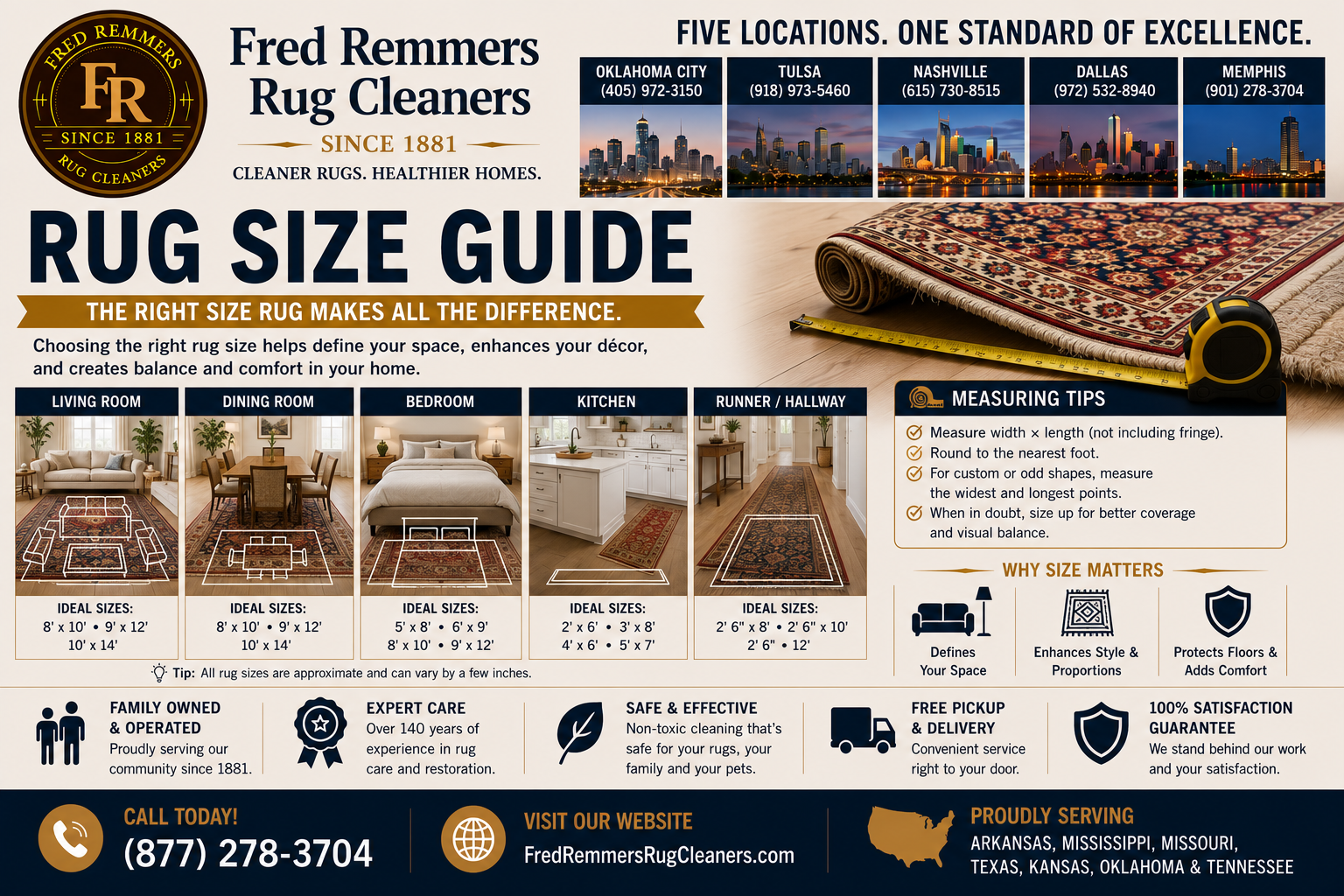
Most machine-made area rugs come in a handful of standard sizes, so it helps to know the common ones before you shop:
- 2×3 and 3×5 — accent rugs for entries, kitchens, and bedsides.
- 4×6 and 5×8 — small living rooms, apartments, and reading nooks.
- 6×9, 8×10, and 9×12 — the workhorses for living and dining rooms.
- 10×14 and larger — big or open-plan rooms.
- Runners — usually about 2.5 feet wide in 6-, 8-, 10-, and 12-foot lengths for halls and kitchens.
One honest caveat for handmade rugs: because every genuine oriental rug is woven by hand, its dimensions rarely land on a perfectly round number — a “9×12” Persian rug might actually measure 8'9" by 12'3". That is a sign of authenticity, not a defect (more on telling the two apart in handmade vs. machine-made rugs). Always measure the real rug, not the label. It is also worth remembering the difference between a rug and wall-to-wall carpet: a rug is meant to float as a defined island of bare floor around it, which is exactly why size matters so much.
Three golden rules that work in any room
Before the room-by-room specifics, these three principles solve ninety percent of sizing questions:
- Anchor the furniture. A rug should connect the pieces in a grouping, with at least the front legs of the sofa and chairs resting on it. A rug too small to touch any furniture looks like an afterthought.
- Leave an even border. Keep a consistent strip of bare floor — roughly 8 to 24 inches, about 18 on average — between the rug and the walls on all sides.
- When in doubt, size up. An undersized rug is the most common decorating mistake. A larger rug makes a room feel bigger; a small one makes it feel cramped.
Interior designers describe three seating layouts, all valid: all legs on the rug (the roomiest look, needs the largest rug), front legs on (the most popular and most forgiving), and all legs off with a smaller rug defining the center (only for tight spaces).
Living room
The living room is where size matters most. Start from your seating group, not the room’s walls. For an average living room, an 8×10 or 9×12 lets you slide the front legs of the sofa and flanking chairs onto the rug, tying the arrangement together. A small apartment seating area can work with a 5×8; a large open-plan space may want a 10×14 or bigger.
The look to avoid is the “postage stamp” — a little rug marooned under the coffee table with all the furniture off it. If your rug can only reach the coffee table, it is too small for the room. Because the living room takes the heaviest foot traffic, it is also the room where a good rug pad and regular care pay off most — see our rug maintenance tips.
Dining room
Dining rooms have the clearest rule of all: the rug must be big enough that the chairs stay on it even when pulled out to sit down. That means the rug should extend at least 24 inches — ideally 30 to 36 — beyond every edge of the table. A chair with its back legs hanging off the rug edge tips and catches, and it looks wrong.
The quick math: measure your table, then add about 5 feet to both the length and the width. A standard six-seat rectangular table usually lands on an 8×10; a larger table or one with a leaf wants a 9×12. For a round table, use a round rug about 4 feet larger in diameter — a 48-inch round table pairs with an 8-foot round rug. Dining rooms see spills, so keep our rug spill first-aid steps handy.
Bedroom
There are two good ways to size a bedroom rug. The generous option is one large rug fully under the bed and nightstands, extending 18 to 24 inches past the sides and foot — an 8×10 under a queen, a 9×12 under a king. The budget-friendly option is to place the rug under only the lower two-thirds of the bed, starting just below the nightstands, so a wide band of soft rug frames the sides and foot where your feet land in the morning.
A third approach skips the big rug entirely: a pair of matching runners, one down each side of the bed, plus an optional runner at the foot. Whichever you choose, the rug should feel like a soft landing, not a narrow strip peeking out.
Hallways and entryways
Runners follow their own rule of thumb: leave about 3 to 5 inches of bare floor on each side and at least 18 inches at each end. A runner that spans nearly wall to wall looks like a carpet remnant; one with an even margin looks intentional. In a long hallway, a single long runner reads better than several small mats, and if you must use two, keep the gap between them even.
Entryways take the most grit and moisture in the house, so an entry rug earns its keep — and needs the most cleaning. That constant traffic is exactly why entry pieces wear fastest; regular professional cleaning keeps them from grinding out.
How to measure and dodge the common mistakes
Two minutes with painter’s tape saves an expensive mistake. Tape out the rug’s footprint on the floor before you buy, then live with it for a day — walk the room, pull out the dining chairs, sit on the sofa — and adjust. It is far easier than returning a heavy rug. The mistakes we see most often:
- Going too small — by a wide margin the number-one error.
- Centering on the room instead of the furniture — the rug should relate to the seating or the table, not just the four walls.
- Forgetting the pad — a pad cut about an inch smaller than the rug on each side keeps it flat and safe on hard floors. See do you need a rug pad and our guide to pad types.
- Ignoring doors and traffic paths — make sure doors clear the rug and thickness and there is room to walk around it.
Still shopping for the rug itself? Our guide to buying an oriental rug without overpaying covers what to check before you pay. Already own a beautiful oriental rug that deserves the right room? Fred Remmers has been an oriental rug gallery since 1881, and we also clean, repair, and appraise. When your rug needs freshening for its new spot, schedule a free pick-up — free pick-up and delivery across all five metros we serve — or get a free estimate. To learn what a piece is worth, see our rug appraisal service.
Common questions about rug sizes.
What size rug do I need for my living room?
For most living rooms an 8×10 or 9×12 rug works best, large enough that at least the front legs of your sofa and chairs sit on it. A 5×8 suits a small apartment seating area, while a large open-plan room may call for a 10×14 or larger. The goal is a rug that anchors the whole seating group, not a small island floating in the middle.
Should all my furniture fit on the rug?
It can, but it does not have to. There are three valid layouts: all legs on the rug (the most spacious look, needs the biggest rug), front legs on the rug (the most common and forgiving), or all furniture off with just a defined center (works only in small rooms). Front legs on is the easiest to get right.
What is the most popular rug size?
The 8×10 and 9×12 are the most popular area rug sizes because they fit the majority of living and dining rooms. The 5×8 is the most popular size for smaller spaces. If you are unsure and have an average-sized room, an 8×10 is the safest starting point.
What size rug goes under a dining table?
The rug should extend at least 24 inches, ideally 30 to 36 inches, beyond every edge of the table so the chairs stay on the rug even when pulled out to sit down. For a standard six-seat rectangular table that usually means an 8×10; for a larger table, a 9×12. Measure your table and add about 5 feet to the length and width.
What size rug goes under a queen or king bed?
An 8×10 rug works under a queen bed and a 9×12 under a king, placed so the rug starts below the nightstands and extends 18 to 24 inches past the sides and foot of the bed. If you want the rug only at the foot or beside the bed, use a smaller rug or two runners instead.
How much bare floor should show around a rug?
Aim to leave a consistent border of bare floor between the rug and the walls, roughly 8 to 24 inches depending on room size, with 18 inches a good average. The border should be even on all sides. Too little floor makes the rug look like wall-to-wall carpet; too much makes it look undersized.
What are the standard rug sizes?
Common standard sizes are 2×3 and 3×5 (accent), 4×6 and 5×8 (small rooms), 6×9, 8×10, and 9×12 (living and dining rooms), and 10×14 and larger for big open spaces. Runners are typically 2.5 feet wide and 6, 8, or 10 feet long. Handmade oriental rugs vary slightly from these round numbers because each is woven by hand.
Is it better to buy a rug too big or too small?
When in doubt, size up. An undersized rug is the single most common decorating mistake, making furniture look disconnected and the room smaller. A slightly larger rug anchors the space and makes a room feel bigger. Just keep a border of bare floor showing on all sides.
What size runner do I need for a hallway?
A runner should leave about 3 to 5 inches of bare floor on each side and 18 or more inches at each end of the hall. Standard runners are 2.5 feet wide in 6, 8, 10, and 12 foot lengths. For a long hallway it looks better to use one long runner, or two with an even gap, than several small mats.
Can I put a rug partly under my bed?
Yes, and it is a common approach. Slide the rug under the lower two-thirds of the bed, starting just below the nightstands, so a wide band of rug frames the sides and foot where your feet land. This lets you use a slightly smaller, less expensive rug than one that covers the entire floor.
What size rug goes under a round dining table?
Use a round rug that is about 4 feet wider in diameter than the table, so chairs stay on the rug when pulled out. A 48-inch round table pairs well with an 8-foot round rug. Matching the rug shape to a round table looks more intentional than a rectangle.
Does my rug pad need to be the same size as my rug?
The pad should be slightly smaller than the rug, about an inch shorter on each side, so it stays hidden underneath and the rug edges still lie flat to the floor. A good pad is cut to fit your exact rug. It cushions the rug, stops slipping, and extends its life, which matters most on hard floors.