Rug terminology glossary
The words used to describe rugs — abrash, pile, foundation, warp, weft, knot count — can be confusing. Here are 32 of the most common rug terms explained in plain English, from a workshop that has hand-finished rugs since 1881.
Quick answer: Every rug has a foundation — the lengthwise warp and crosswise weft threads — topped by a pile of knots. A hand-knotted rug has each knot tied by hand and is the most durable and valuable; hand-tufted and machine-made rugs are made faster and last less long; a kilim is flat-woven with no pile. Wool is the most common fiber, silk is used in the finest pieces, and knot count (KPSI) measures how finely a rug is woven.
The 30-second version. Full definitions for all 32 terms — from abrash to silk — are below.
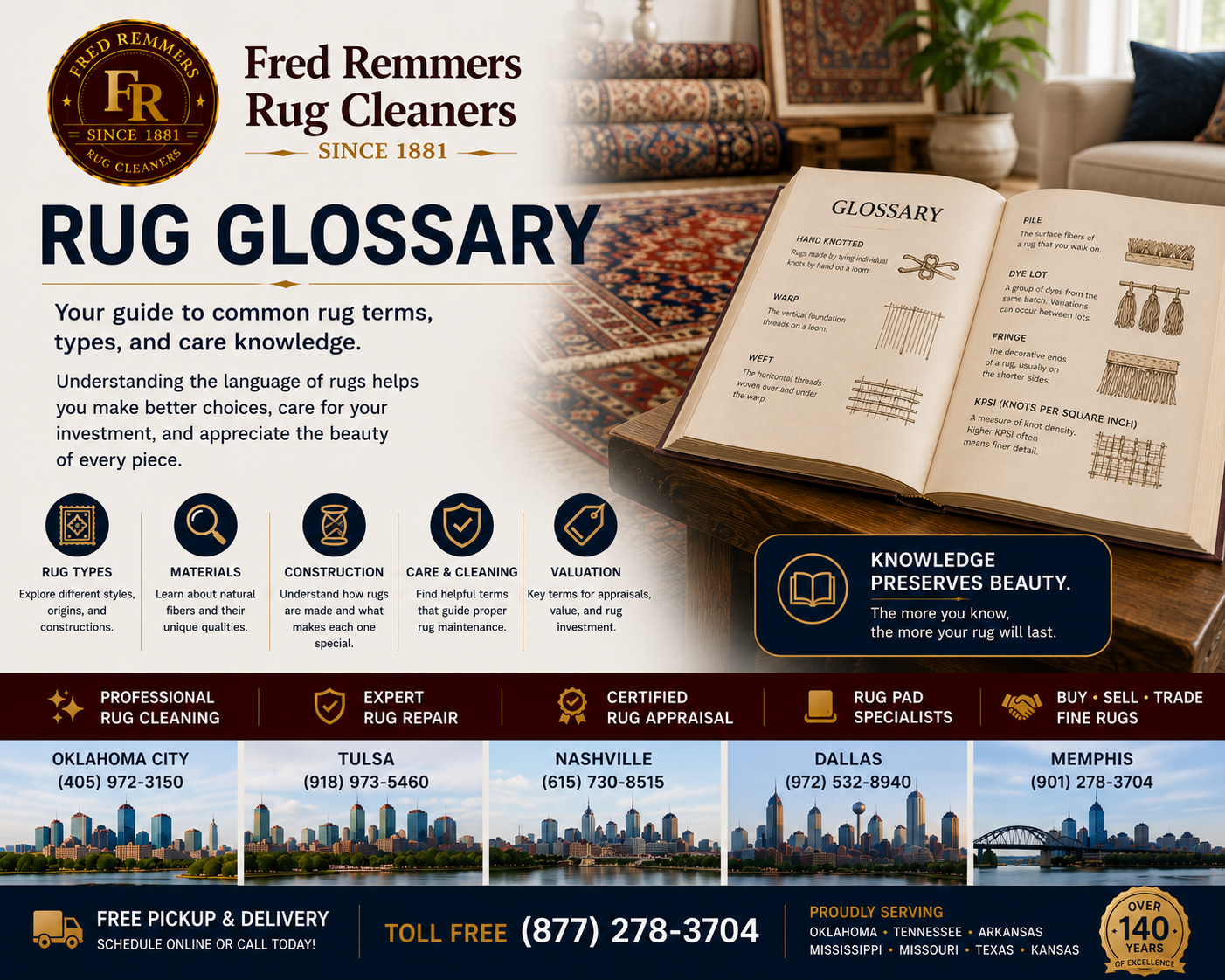
Knowing a few basic terms makes it far easier to shop for, care for, and value a rug. These are the words we use every day in the workshop, explained simply.
- Abrash
- Natural variation in color across a hand-knotted rug, caused by small differences between dye batches of wool. It is a hallmark of a genuine handmade rug, not a flaw.
- Pile
- The soft, raised surface of a rug that you walk on, made of the cut or looped ends of the knots. Pile height affects how plush a rug feels and how much dust it holds.
- Foundation
- The structural base of a rug, made of the warp and weft threads that the pile knots are tied to. A sound foundation is what lets a rug be cleaned and repaired for generations.
- Warp
- The vertical foundation threads that run the length of a rug, from fringe to fringe. The knots of a hand-knotted rug are tied around pairs of warp threads.
- Weft
- The horizontal threads woven between the warps to lock each row of knots in place and hold the rug together.
- Knot count (KPSI)
- The number of knots per square inch, a common measure of how finely a rug is woven. Higher knot counts mean finer detail and more labor, but not automatically higher quality.
- Hand-knotted
- A rug in which every knot is tied by hand around the foundation threads. It is the most durable and valuable construction, and the type most worth cleaning and repairing.
- Hand-tufted
- A rug made by punching yarn through a fabric backing with a tool, then gluing a second backing on. It is faster and cheaper to make than hand-knotted and does not last as long — see hand-knotted vs. hand-tufted.
- Machine-made
- A rug woven by power loom rather than by hand. The back usually looks uniform and the fringe is often sewn or glued on, rather than being part of the foundation.
- Kilim
- A flat-woven rug with no pile, made by interweaving the warp and weft directly. Kilims are reversible and thinner than knotted rugs.
- Fringe
- The exposed ends of the warp threads at the two ends of a rug. On a handmade rug the fringe is part of the foundation, not an added decoration.
- Selvage (selvedge)
- The finished edge running along the two long sides of a rug, where the wefts wrap the outer warps to keep the rug from unraveling.
- Overcasting
- A protective stitch wrapped around the side edges of a rug by hand to reinforce or repair the selvage.
- Serging vs. binding
- Two ways to finish a rug’s edge: serging wraps the edge in yarn, usually by machine, while binding sews a fabric strip over it. See binding vs. serging.
- Lanolin
- The natural oil in wool that gives it luster, softness, and resistance to soil and stains. Harsh chemicals and hot water strip lanolin, which is why wool rugs need gentle cleaning.
- Dry rot
- Deterioration of a rug’s foundation caused by prolonged moisture, which makes the rug brittle so it cracks or tears. It is a common result of a rug left damp.
- Reweaving
- A hand repair that rebuilds missing or damaged pile and foundation, knot by knot, to match the original weave and pattern. See our rug reweaving service.
- Medallion, field, and border
- The main design elements of many oriental rugs: the central medallion, the surrounding open field, and the framing border bands.
- Wool
- The most common rug pile fiber. It is durable, resilient, naturally soil- and flame-resistant, and holds dye well, which is why quality rugs last for generations.
- Silk
- A fine, lustrous, and delicate fiber used in high-end rugs. Silk rugs are costly to make and require gentler, more specialized cleaning than wool.
- Oriental rug
- A handmade rug woven in the traditional rug-making regions of the Middle East, Central Asia, South Asia, and China. Persian, Turkish, Caucasian, Indian, and Chinese rugs are all types of oriental rug.
- Persian rug
- An oriental rug woven in Iran, historically called Persia. Persian rugs are prized for fine weaving and classic patterns, and are often named for the city or region where they were made, such as Tabriz, Kashan, or Heriz.
- Antique rug
- A rug that is generally 100 years or older. A rug roughly 50 to 100 years old is often called semi-antique. Age alone does not set value; condition, weave, and rarity matter too.
- Runner
- A long, narrow rug made for hallways, staircases, and other tight spaces. Runners are usually two to three feet wide and can be many feet long.
- Area rug
- A rug that covers part of a floor to define or anchor a space, as opposed to wall-to-wall carpet. Area rugs can be handmade or machine-made and come in many sizes.
- Dhurrie
- A flat-woven rug traditionally made in India, similar to a kilim, with no pile. Dhurries are typically cotton or wool and are reversible.
- Soumak
- A flat-weave technique that wraps the weft yarns around the warps to create a smooth, slightly raised, herringbone-like surface. Soumak rugs are flat but thicker and sturdier than a plain kilim.
- Vegetable dye (natural dye)
- Dye made from plants, roots, and insects, used before synthetic dyes existed. Natural dyes age gracefully and are one reason antique rugs develop rich, mellow color, including abrash.
- Persian vs. Turkish knot
- The two main hand-knotting methods. The Persian (Senneh) knot is asymmetric and suits fine, curved designs; the Turkish (Ghiordes) knot is symmetric and very durable. Both are tied by hand around the warp threads.
- Moth damage
- Harm caused by clothes-moth larvae, which eat wool pile and can leave bare or thin patches, especially in dark, undisturbed areas. Regular cleaning and use deter moths, and the damage can be rewoven — see moth damage in wool rugs.
- Color run (dye bleed)
- When a rug’s dyes migrate into neighboring areas, usually because it got wet and dried too slowly or was cleaned with water that was too hot. Stable dyes and controlled drying prevent it; our color-run removal can often correct it.
- Rug pad
- A cushioning underlay placed beneath a rug. A good pad reduces slipping, adds comfort, improves airflow, and protects the rug by cushioning it against abrasive grit — see whether you need a rug pad.
Still not sure what your rug is made of or how it was made? We are glad to tell you. Fred Remmers has hand-cleaned, repaired, and appraised rugs since 1881 — request a free estimate or a formal rug appraisal, and see our full rug cleaning service. Pick-up and delivery are free across all five metros we serve.
Keep reading.
How to tell if a rug is handmade or machine-made
Flip it over — the back, fringe, and pile reveal how your rug was made in about a minute.
Hand-knotted vs. hand-tufted rugs
Two very different constructions, two very different lifespans — and how to spot each.