Rug binding vs. serging: what's the difference?
Every rug needs a finished edge to keep it from unraveling — and there are two main ways to do it. Binding wraps the edge in fabric tape; serging wraps it in yarn. Here is how they differ in look, durability, and cost, and which one suits your rug.
Quick answer: Both finish a rug’s raw side edge so it cannot unravel — they just do it differently. Binding wraps the edge in a strip of fabric tape, giving a clean, modern band; it suits machine-made and cut-down rugs. Serging (and its hand version, overcasting) wraps the edge in yarn for a traditional look that matches oriental and hand-knotted rugs. If your rug is handmade or valuable, serging or hand overcasting is almost always the right choice.
Key takeaways
- Both finishes stop a rug’s edge from unraveling — they look and wear differently.
- Binding wraps the edge in fabric tape: clean and modern, ideal for machine-made and cut-down rugs.
- Serging / overcasting wraps the edge in yarn: the traditional match for oriental and hand-knotted rugs.
- A failing edge exposes the foundation — finishing it promptly prevents a bigger repair.
Why rug edges need finishing
A rug is a woven structure held together under tension. The pile knots are anchored to horizontal wefts and vertical warps, and along the two long sides those warps are bundled into a selvedge — the rug’s built-in edge. The short ends are secured by the fringe, which is the warp threads themselves. If any of these edges fails, the weave at the perimeter starts to let go, and from there the damage works inward.
That is why every finished rug has some kind of edge treatment, and why a worn or damaged edge should be addressed quickly. Binding and serging are the two main ways to finish or restore a rug’s long side edges. (The fringed short ends are a separate job — see why your rug fringe is unraveling.)
What binding is
Binding wraps the raw edge of the rug in a strip of fabric — usually a cotton or synthetic binding tape — folded over the edge and machine-sewn into place. The result is a clean, uniform band of fabric running along the side, much like the finished edge of a wall-to-wall carpet that has been cut to size.
Binding is quick, economical, and tidy, which makes it the standard choice for machine-made rugs, carpet remnants turned into area rugs, and any rug that has been cut down to a new size and needs a fresh edge. It comes in many colors so the band can blend with or contrast the rug. What it is not is traditional — a fabric band looks distinctly modern next to a hand-knotted oriental rug.
What serging and overcasting are
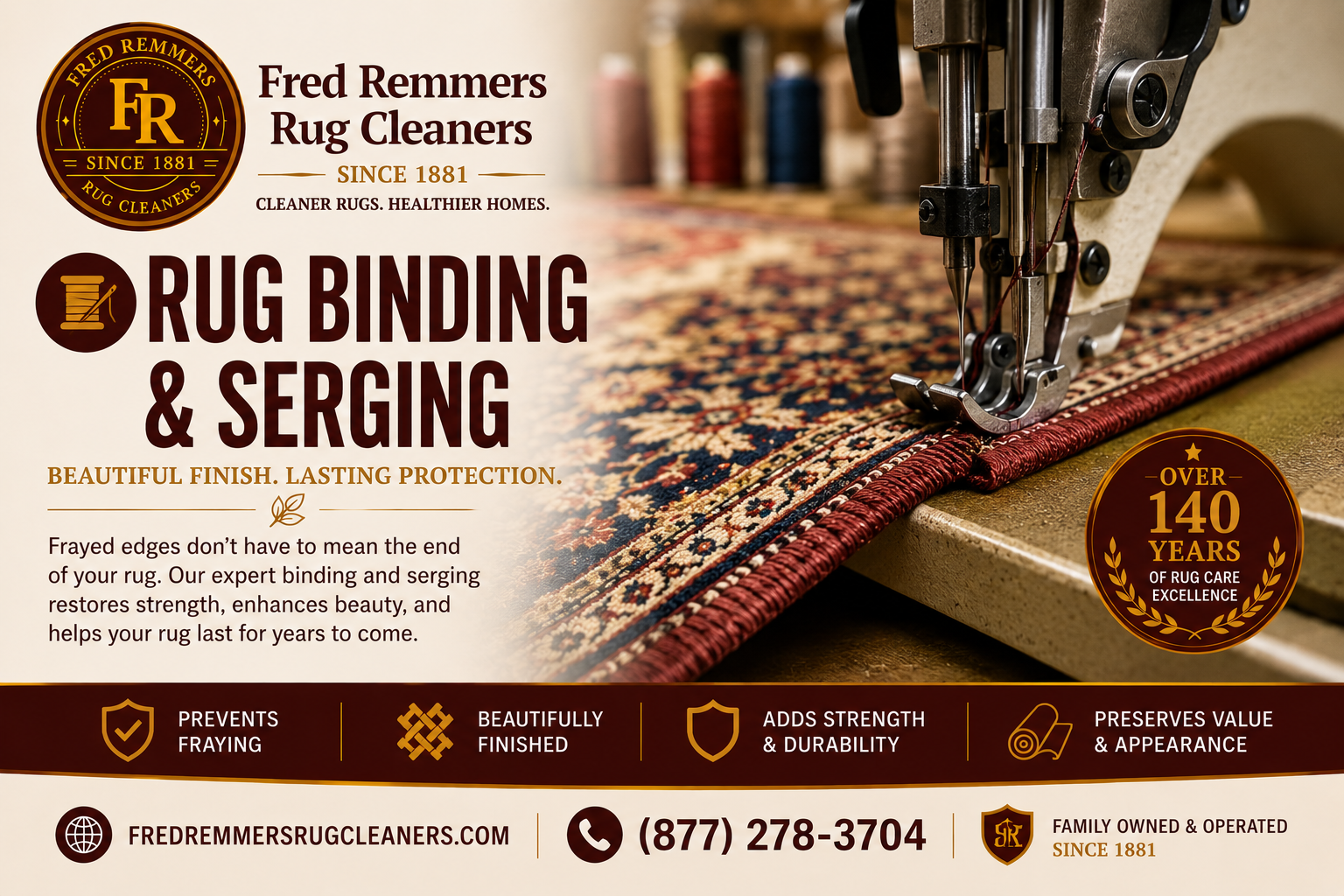
Serging finishes the edge with yarn instead of fabric. A serging machine wraps thread tightly over the side cords in a continuous row, producing a finished edge that looks like a band of wrapped yarn — the same look a traditional handmade selvedge has. It flexes with the rug and, with matching yarn, all but disappears into the design.
Overcasting is the hand version of the same idea: yarn wrapped around the side edge by hand, stitch by stitch. It is slower and more skilled work, and it is what we use on finer, antique, and hand-knotted rugs, and for edge repairs where the new work must match the original exactly. Both serging and overcasting keep a rug looking like what it is — a woven textile rather than a bound mat.
Binding vs. serging: the differences
- Material — binding uses a fabric tape; serging and overcasting use yarn.
- Look — binding gives a clean, modern fabric band; serging gives a traditional wrapped-yarn edge that suits oriental rugs.
- Best suited to — binding for machine-made, synthetic, and cut-down rugs; serging or overcasting for wool, oriental, and hand-knotted rugs.
- Flexibility — a yarn edge flexes and wears in step with the rug; a fabric band is stiffer and can wear differently from the pile.
- Cost and effort — machine binding is the quickest and most economical; serging is more involved, and hand overcasting is the most labor-intensive of the three.
Which is right for your rug
The rug’s construction usually decides it. For a genuine hand-knotted or antique oriental rug, serging or hand overcasting in matching wool preserves both the look and the value — a fabric binding would look out of place and can actually lower the appeal of a fine piece. For a machine-made rug, a synthetic rug, or one you have cut down to fit a room, binding is clean, durable, and cost-effective.
If you are not sure what you have, that matters here too, because the right edge depends on how the rug was made. A quick look at the back settles it — see how to identify a hand-knotted rug. When in doubt, we will tell you which finish fits the rug.
Can you DIY an edge?
There are iron-on binding tapes and basic kits sold for home use, and for a cheap, low-stakes rug they can be a reasonable stopgap. But a lasting, good-looking edge needs the right materials, correct tension, and matching yarn or tape — get any of those wrong and the edge puckers, the rug curls, or the new work unravels within months. On a wool or hand-knotted rug, an improvised edge can also distort the foundation. For anything you care about, professional binding or serging is well worth the modest cost.
Get your edges restored
Whether your rug needs a clean new binding or serging, traditional hand overcasting and stitching, or broader edge and foundation repair, Fred Remmers has finished and restored rug edges by hand since 1881. We will match the method to your rug and tell you honestly what it needs. Schedule a free pick-up — pick-up and delivery are free across all five metros we serve.
Common questions about rug edges.
What is the difference between rug binding and serging?
Binding wraps the raw edge of a rug in a strip of fabric tape that is machine-sewn into place, giving a clean, finished fabric band. Serging wraps the edge in yarn, stitched over the side cords to mimic a traditional handmade selvedge. Binding suits machine-made and cut-down rugs; serging suits oriental and hand-knotted rugs.
Which edge finish is better for an oriental rug?
Serging, or hand overcasting, is the right match for an oriental or hand-knotted rug. Wrapping the side edges in matching yarn preserves the traditional look and flexes with the rug, where a stiff fabric binding can look out of place and wear differently from the rug itself.
Is binding or serging more durable?
Both are durable when done well. A hand-overcast or serged yarn edge tends to wear in step with the rug and can be repaired in sections, while fabric binding gives a tough, clean band that holds up well on machine-made rugs. The best choice depends on the rug’s construction and how it is used.
What is overcasting and how is it different from serging?
Overcasting is essentially the hand version of serging: yarn wrapped around the rug’s side edge by hand rather than by machine. It is used on finer, antique, and hand-knotted rugs and for edge repairs, because it is more authentic and can be matched precisely to the original.
Can I bind or serge a rug myself?
Light DIY edge fixes exist, but a lasting, good-looking result needs the right materials and technique. Done poorly, edge work can pucker, unravel, or distort the rug. For any rug you value, professional binding or serging is well worth it.
Can a rug be re-bound or re-serged when the edge wears out?
Yes. Worn binding can be removed and replaced, and a tired serged or overcast edge can be restitched. Addressing a failing edge early keeps the rug’s foundation from unraveling and avoids a larger, more expensive repair later.
How much does rug binding or serging cost?
Cost depends on the length of the edge, the method, and the rug’s construction, so it is quoted per rug rather than by a flat rate. Serging and hand overcasting are more labor-intensive than machine binding. We provide an honest estimate when we assess the rug.
Keep reading.
Why your rug fringe is unraveling
Fringe failure is usually an early warning that the foundation is coming apart. What each repair option does.
Hand-knotted vs. hand-tufted: how to tell
The difference is invisible from the front but unmistakable on the back — and it decides the right edge finish.