How to remove pet stains from a rug.
A pet accident on a good rug is a race against time — the faster you blot and treat it, the more you save. But the wrong cleaner does more damage than the stain. Here is how to remove pet stains safely, and when a rug needs a professional wash.
Quick answer: Blot up as much as you can with a clean cloth right away — don’t rub. Rinse the spot with cool water and blot again; for a fresh stain a mild vinegar-and-water solution (tested on a hidden corner first) can help. Never use bleach, ammonia, hydrogen peroxide, or a steam cleaner on a wool or oriental rug — they strip dyes and set stains. Fresh surface stains often lift at home, but set-in urine and recurring odor live deep in the foundation and need a professional immersion wash to fully remove.
Key takeaways
- Act fast: blot (never rub) and rinse a fresh stain with cool water.
- Safe on wool: a tested, diluted vinegar-and-water solution. Unsafe: bleach, ammonia, peroxide, steam.
- Odor that keeps returning means urine crystals are deep in the foundation — surface cleaning won’t reach them.
- Set-in urine and fine or antique rugs need professional pet-stain removal to protect the dyes.
Act fast on fresh stains
When a pet has an accident on a rug, the clock starts immediately. Fresh urine is mostly water and far easier to remove than urine that has dried and soaked into the foundation. Within hours it begins to concentrate into salts and can start reacting with the wool’s dyes — which is why a stain you catch right away is often fully recoverable, while one discovered days later may not be. (For the full chemistry, see our guide to the pet urine damage timeline.)
So the single most important thing you can do is act quickly and gently. Grab clean white cloths or paper towels and get to work before the accident sets.
How to remove a fresh pet stain
For a fresh accident on a wool or oriental rug, work in this order:
- Blot, don’t rub. Press a clean, dry cloth firmly into the spot to soak up as much liquid as possible. Rubbing pushes urine deeper and frays the fibers. Keep switching to a dry part of the cloth.
- Rinse with cool water. Lightly dampen the area with cool (never hot) water to dilute what is left, then blot again. Repeat until the cloth comes up mostly clean.
- Try a mild solution — carefully. A 1:1 mix of white vinegar and cool water can help neutralize a fresh stain on wool. Test it on a hidden corner first to make sure the dyes are stable, apply sparingly, and blot — don’t soak the rug.
- Blot dry and air it out. Press out the moisture with dry towels, then let the spot dry with good airflow (a fan helps). Don’t use heat to speed it up.
- Lift the rug to check underneath. Urine travels through to the rug pad and floor. Dry both sides and the pad so moisture and odor don’t linger.
That routine handles the surface of a fresh accident. What it cannot do is reach urine that has already soaked into the foundation — more on that below.
What never to use on a wool rug
Most of the permanent pet-stain damage we see doesn’t come from the pet — it comes from the cleaner. On a wool or oriental rug, never use:
- Bleach or hydrogen peroxide — they strip or lighten wool dyes, leaving a pale spot worse than the stain.
- Ammonia or ammonia-based cleaners — ammonia is a component of urine, so to a pet it smells like a marking spot and actually encourages repeat accidents.
- Harsh carpet or upholstery chemicals — formulas made for synthetic wall-to-wall carpet can be far too aggressive for natural wool and silk.
- Steam cleaners and hot water — heat sets protein-based stains and can shrink or felt wool. Here is why steam cleaning damages wool rugs.
- Vigorous scrubbing — it distorts the pile and drives the stain deeper.
Enzyme-based pet cleaners are designed to break down urine and can work on durable rugs, but on fine wool, silk, or antique pieces they should be used cautiously and tested first — when in doubt, leave those to a professional.
Why the smell keeps coming back
This is the part that surprises people: you clean the spot, it looks fine, and a week later — especially on a humid day — the smell is back. Here is why.
As urine dries, it leaves behind concentrated salts and crystals that bond deep in the rug’s foundation and in the pad beneath it. Surface cleaning removes what is on top but never reaches those crystals. When humidity rises, the crystals reactivate and release odor all over again. It is the same mechanism behind a general musty rug smell, concentrated at the accident site.
The only way to remove that odor at the source is to flush the crystals completely out of the rug — which takes a full-immersion wash, not a spot treatment. That is exactly what our deodorizing and pet-stain removal services are built to do.
Old and set-in stains
Dried, older pet stains are a different situation from a fresh accident, and it pays to be honest about them:
- Color change may be permanent. Over days and weeks, urine chemically alters wool dyes — often shifting a color toward yellow, brown, or a bleached tone. Once the dye itself has changed, cleaning removes the residue but cannot always restore the original color.
- Odor is deeply set. The longer crystals sit, the more thoroughly they bond into the foundation, and the more washing it takes to remove them.
- Some damage needs restoration, not just cleaning. Where dye or fibers are damaged, repair work such as re-dyeing or reweaving may be the path back — something only a specialist can assess.
None of this means an old stain is hopeless. It means the realistic goal shifts from “make it vanish at home” to “have it professionally assessed and treated” — and the sooner, the better the odds.
When to call a professional
Blotting a fresh accident is something anyone can do. But bring in a professional when:
- The rug is wool, silk, antique, or valuable — the fibers and dyes are too easy to damage with DIY chemicals.
- The stain has dried or set in, or you found it well after the fact.
- The odor keeps returning no matter how many times you clean the spot.
- There are repeat accidents in the same area, meaning urine has built up in the foundation.
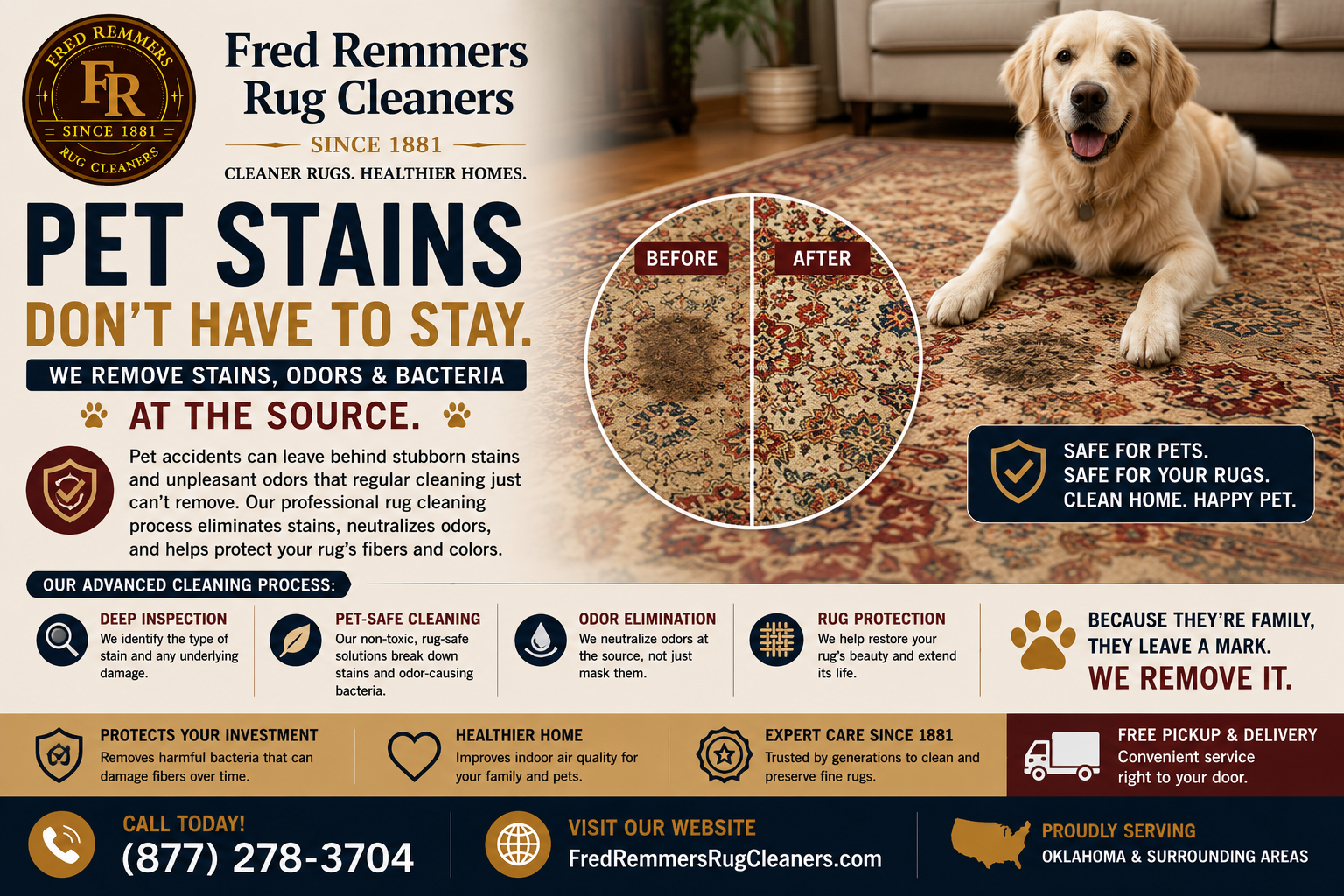
A professional wash submerges the whole rug, flushes the urine salts completely out of the foundation and pad, and dries it under controlled conditions — removing the stain and the odor at the source instead of masking them. The same deep flush also clears out the pet dander and allergens that settle into the pile, which matters if anyone in the home has allergies. Fred Remmers has hand-washed rugs since 1881; if a pet accident has your rug smelling or stained, schedule a free pick-up and we will take care of it. Pick-up and delivery are free across all five metros we serve. See our full rug cleaning service for what is included.
Common questions about pet stains on rugs.
How do you get pet stains out of a rug?
Act fast. Blot up as much as you can with a clean cloth without rubbing, rinse the spot with cool water, and blot again. On a wool rug a tested, diluted vinegar-and-water solution can help. Fresh surface stains often lift this way, but set-in urine and lingering odor need a professional wash.
How quickly should I clean a fresh pet accident on a rug?
As soon as possible, ideally within minutes. Blot up the moisture right away with dry towels before it soaks into the foundation and pad. The longer urine sits, the deeper it travels and the more likely it is to cause permanent dye damage or lasting odor, especially on wool. Blot fast at home, then get professional cleaning for anything beyond a minor spot.
What removes pet urine smell from a rug?
The smell comes from urine salts and crystals soaked deep into the foundation, where surface cleaning cannot reach. Blotting and airing help a fresh accident, but recurring odor means the crystals are still there, and only a full immersion wash removes them.
Can I use vinegar to clean pet stains on a rug?
A diluted white-vinegar-and-water solution can help neutralize a fresh stain on a wool rug and is gentler than most cleaners. Test it on a hidden corner first, avoid it on silk and delicate antiques, and never use it hot.
Does baking soda remove pet stains from a rug?
Baking soda can absorb some surface odor and moisture, but it does not remove a pet stain or the urine crystals bonded deep in the foundation. It is a reasonable first-aid step to blot and lightly deodorize a fresh spot, but the smell usually returns because the source is still in the rug. A full wash is what actually removes it.
What should I not use on pet stains on a wool rug?
Avoid bleach, hydrogen peroxide, ammonia, and harsh carpet chemicals, which strip or change wool dyes. Skip steam cleaners and hot water, which set the stain and can damage wool. Ammonia is especially bad because it smells like urine and encourages re-marking.
Are old, dried pet stains permanent?
Sometimes. Over time urine chemically changes wool dyes, and that color loss can be permanent even after the stain is cleaned. The sooner it is treated the better, and a specialist can tell you what is recoverable and whether re-dyeing or reweaving is needed.
Why does my rug still smell after I cleaned it?
Because DIY cleaning reaches the surface, not the urine crystals bonded deep in the foundation and pad. When humidity rises the crystals reactivate and the smell returns. A professional immersion wash flushes them out completely.
What is the difference between removing a pet stain and removing the odor?
The stain is the visible mark; the odor comes from urine salts and bacteria left deep in the foundation. You can often lift the visible stain from the surface while the odor stays behind, which is why a rug can look clean but still smell. Removing the odor for good takes flushing those crystals out with a full immersion wash, not just treating the surface.
Why does my pet keep peeing on the same spot of the rug?
Because leftover urine scent signals a marking spot. Even after surface cleaning, urine crystals and their odor stay deep in the rug, and pets are drawn back to re-mark where they smell it. Ammonia-based cleaners make this worse, since ammonia smells like urine to a pet. Fully removing the odor at the source is usually what breaks the cycle.
Should I get pet stains professionally removed?
For a fine wool, silk, or antique rug, or any stain that has set in or keeps smelling, yes. Professional pet-stain removal and a full wash protect the dyes and remove odor at the source rather than masking it.
Keep reading.
Pet urine on a wool rug: the real damage timeline
What happens hour by hour after an accident — and why every hour lowers what can be recovered.
Spilled something on your wool rug? Do this first
The first-aid steps for any spill on a wool rug — blot, rinse, and what to keep away from it.